
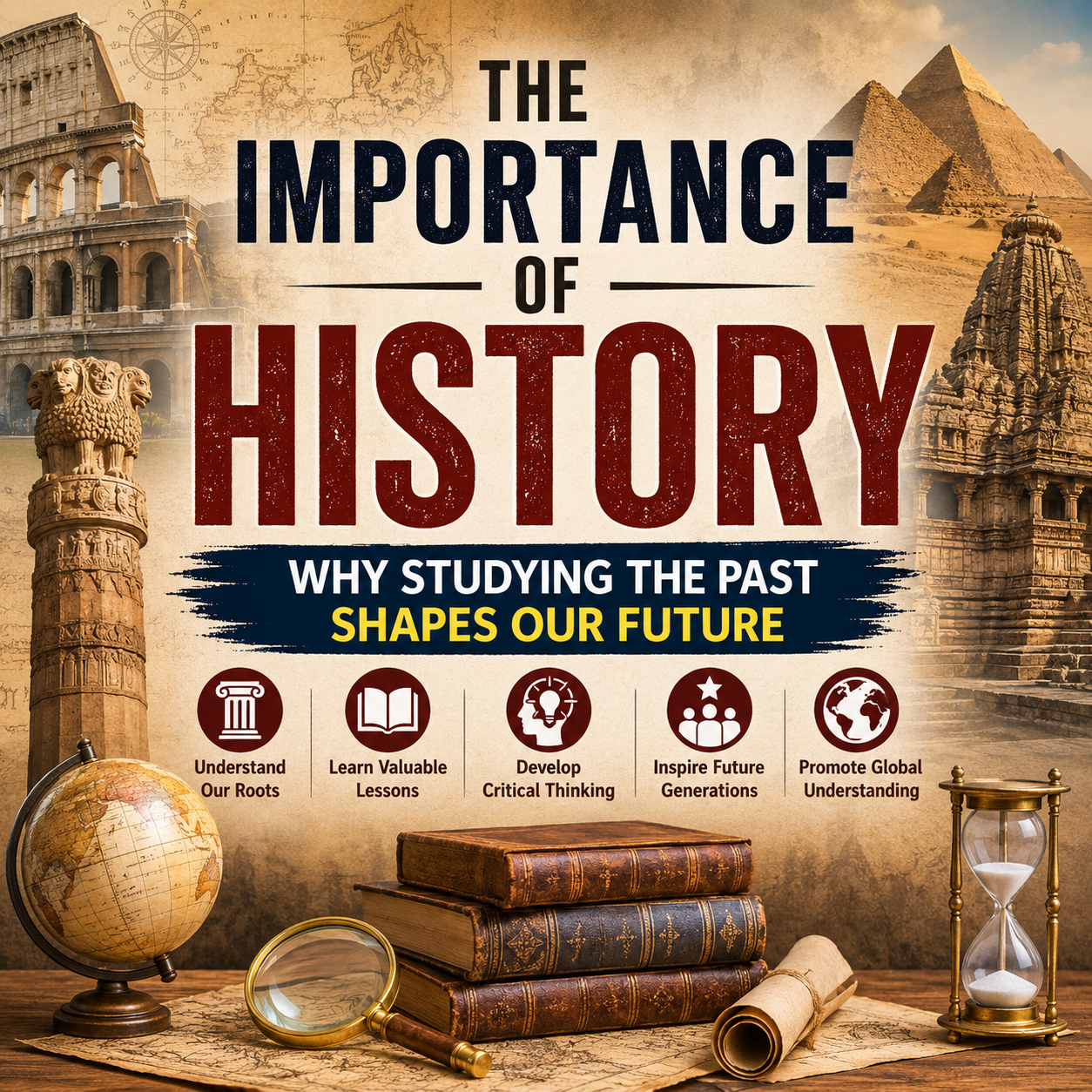
The Importance of History: Why Studying the Past Shapes Our Future
History is much more than a collection of dates, wars, and famous rulers. It is the story of humanity. Every civilization, invention, revolution, and cultural tradition has contributed to the world we live in today. By studying history, we gain valuable knowledge about the successes and failures of the past, helping us make better decisions for the future.
What Is History?
History is the study of past events based on evidence such as written records, inscriptions, archaeological discoveries, monuments, coins, and oral traditions. Historians carefully examine these sources to understand how people lived, how societies developed, and how important events changed the course of civilization.
Why Is History Important?
1. Helps Us Understand Our Roots
History explains where we come from. It teaches us about our ancestors, cultures, languages, and traditions, helping us appreciate our identity and heritage.
2. Teaches Valuable Lessons
Many historical events demonstrate the consequences of good and bad decisions. By learning about past mistakes, societies can avoid repeating them and build a better future.
3. Develops Critical Thinking
History encourages students to examine evidence, compare different viewpoints, and draw logical conclusions. These skills are valuable in education, careers, and everyday life.
4. Inspires Future Generations
The achievements of great leaders, scientists, explorers, and reformers inspire people to overcome challenges and contribute positively to society.
5. Promotes Global Understanding
Learning about different civilizations and cultures helps us respect diversity and understand how nations have influenced one another throughout history.
Major Periods of World History
- Prehistoric Age: Before the invention of writing.
- Ancient History: Early civilizations such as Mesopotamia, Egypt, the Indus Valley, China, Greece, and Rome.
- Medieval History: The rise of kingdoms, empires, religions, and trade networks.
- Early Modern Period: Exploration, the Renaissance, and scientific discoveries.
- Modern History: Industrialization, world wars, technological advancement, and globalization.
Famous Ancient Civilizations
Some of the world’s most influential civilizations include:
- Mesopotamian Civilization
- Ancient Egyptian Civilization
- Indus Valley Civilization
- Ancient Chinese Civilization
- Greek Civilization
- Roman Civilization
- Maya Civilization
These civilizations made remarkable contributions to mathematics, architecture, law, science, literature, and governance.
History of India in Brief
- Indus Valley Civilization was among the earliest urban civilizations.
- The Vedic Period shaped Indian culture and philosophy.
- The Maurya Empire united much of the Indian subcontinent.
- The Gupta Empire is often called India’s Golden Age because of achievements in science, mathematics, literature, and art.
- The Delhi Sultanate and Mughal Empire influenced architecture, administration, and culture.
- The British colonial period lasted for nearly two centuries.
- India gained independence on 15 August 1947, beginning a new chapter as a democratic nation.
Sources of History
Historians rely on different types of evidence, including:
- Archaeological remains
- Ancient manuscripts
- Inscriptions
- Coins
- Monuments
- Paintings
- Oral traditions
- Government records
- Letters and diaries
These sources help reconstruct historical events with greater accuracy.
Benefits of Studying History
- Understand cultural diversity.
- Improve analytical and research skills.
- Appreciate historical monuments and heritage.
- Develop informed opinions about current events.
- Build responsible citizenship.
- Learn from past achievements and failures.
Conclusion
History is the bridge between the past and the present. It helps us understand how civilizations evolved, how societies changed, and how individuals shaped the world. Every historical event carries lessons that remain relevant today. Whether you are preparing for competitive exams, improving your general knowledge, or simply exploring the past, studying history enriches your understanding of the world and inspires a brighter future.
History is not just about remembering the past. It is about learning from it to create a better tomorrow.



Leave a Reply