
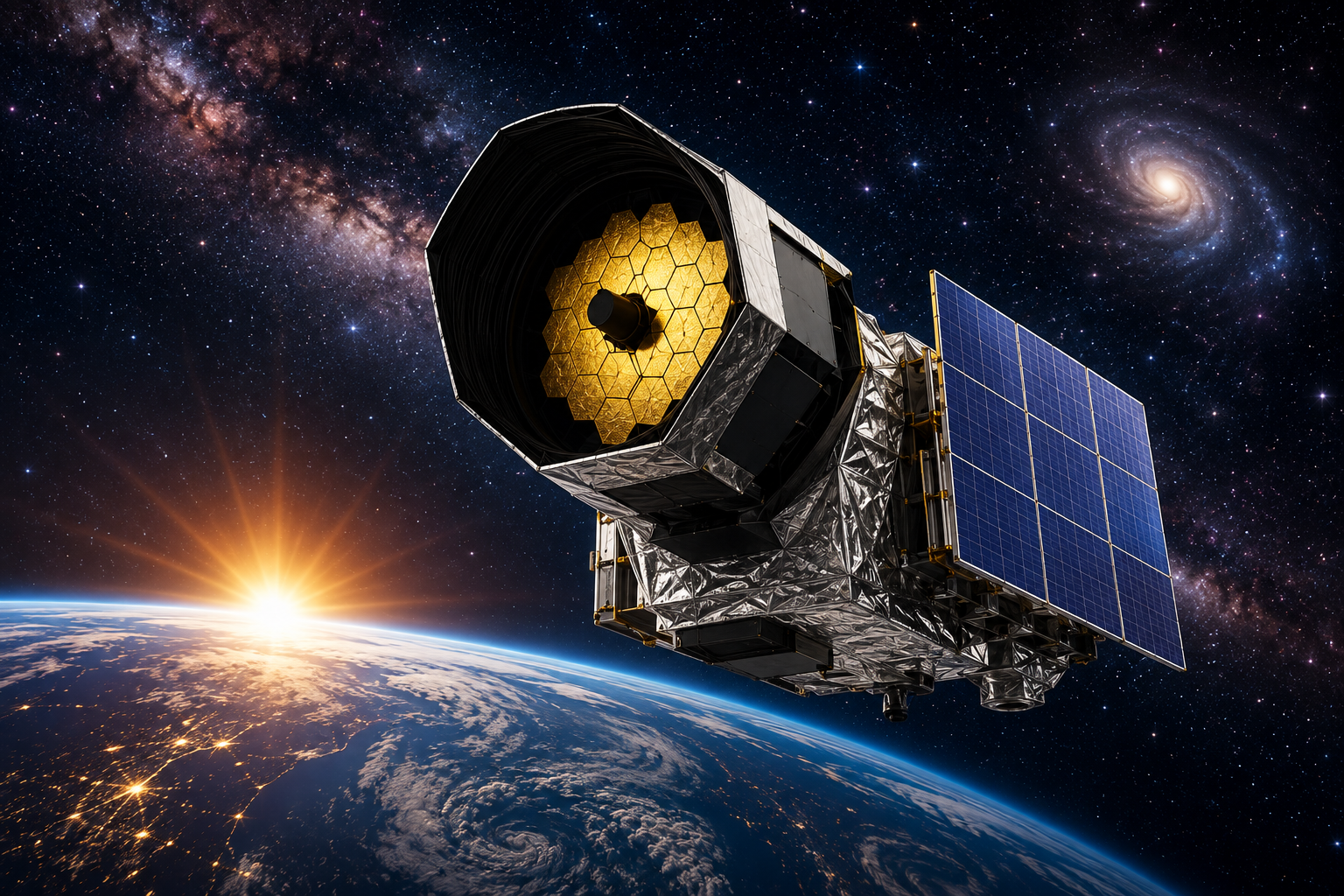
NASA’s Roman Space Telescope Nears Historic Launch to Explore the Universe
NASA is preparing for the launch of the Nancy Grace Roman Space Telescope, one of the most advanced space observatories ever built. The mission is scheduled for 30 August 2026 and is expected to begin a new era of astronomical research by helping scientists explore some of the universe’s greatest mysteries.
The Roman Space Telescope has been designed to study dark matter, dark energy, distant galaxies, and thousands of planets outside our Solar System. Scientists believe the mission will provide valuable information about how the universe formed, evolved, and continues to expand.
Wide-Field View of the Universe
Unlike previous space telescopes, the Roman Telescope combines a large mirror with an exceptionally wide field of view. This allows astronomers to capture detailed images of huge regions of space in a single observation, making it easier to discover new galaxies, star clusters, and other cosmic structures.
Studying Dark Energy
One of the telescope’s main scientific goals is to investigate dark energy, the mysterious force believed to be responsible for the accelerating expansion of the universe. Although dark energy is estimated to make up nearly 70% of the universe, scientists still do not fully understand its nature.
Search for New Exoplanets
The Roman Space Telescope will also search for thousands of exoplanets using the gravitational microlensing technique. Many of these planets may be impossible to detect with other methods, giving astronomers a better understanding of how planetary systems develop across the galaxy.
Advanced Coronagraph Technology
The mission includes a powerful coronagraph instrument that blocks the bright light of stars, allowing scientists to directly observe nearby planets and study their atmospheres. This technology may help researchers learn more about potentially habitable worlds.
Working Alongside James Webb
Scientists expect the Roman Space Telescope to complement the James Webb Space Telescope. While Webb performs detailed observations of individual celestial objects, Roman will survey much larger areas of the sky and identify new targets for further investigation.
Key Highlights
- Launch planned for 30 August 2026
- Will investigate dark matter and dark energy
- Expected to discover thousands of exoplanets
- Features an advanced wide-field imaging system
- Will support future astronomical discoveries
- Named after NASA astronomer Nancy Grace Roman
Conclusion
The launch of the Nancy Grace Roman Space Telescope represents another major milestone in space exploration. By observing billions of galaxies and searching for distant planets, the mission is expected to expand our understanding of the universe and inspire future generations of scientists and space enthusiasts.



Leave a Reply