
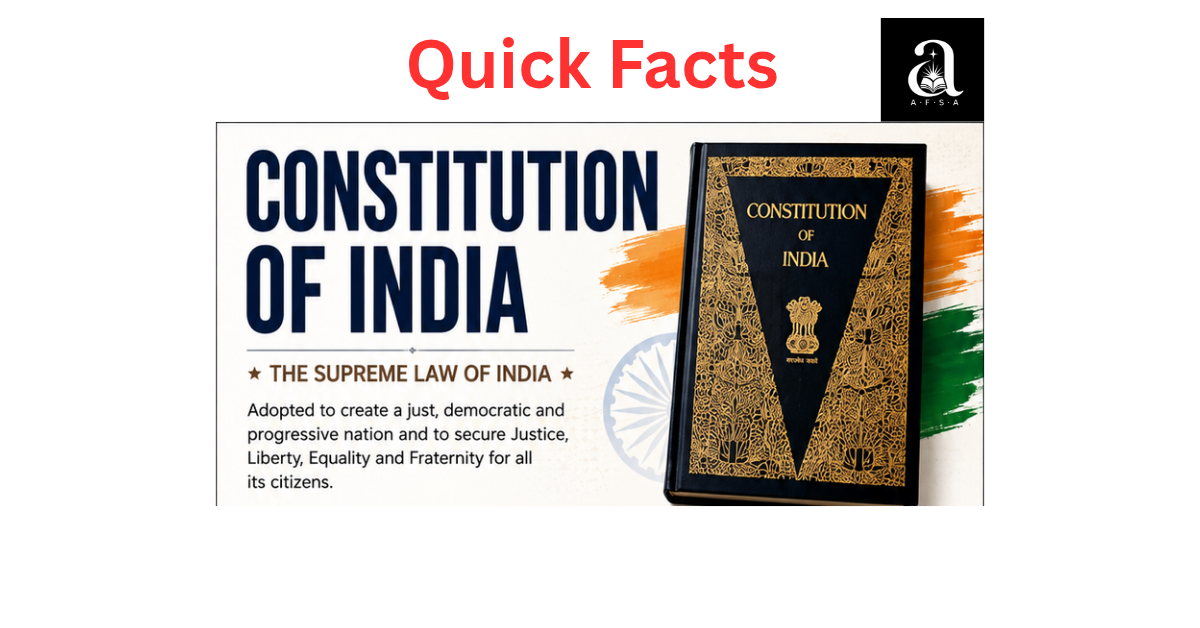

100 One-Liner Facts About the Constitution of India
1. The Constitution of India is the supreme law of the country.
2. It was adopted on 26 November 1949.
3. It came into force on 26 January 1950.
4. India celebrates Constitution Day on 26 November.
5. India celebrates Republic Day on 26 January.
6. The Constitution was drafted by the Constituent Assembly.
7. The Constituent Assembly first met on 9 December 1946.
8. Dr. B. R. Ambedkar was the Chairman of the Drafting Committee.
9. Dr. B. R. Ambedkar is known as the Chief Architect of the Constitution.
10. The Drafting Committee was formed on 29 August 1947.
11. The Constitution took nearly 2 years, 11 months, and 18 days to prepare.
12. The Constituent Assembly held 11 sessions.
13. It met for 165 days.
14. The original Constitution was handwritten.
15. It was calligraphed by Prem Behari Narain Raizada.
16. The original Constitution was illustrated by Nandalal Bose and his team.
17. The original Constitution is preserved in Parliament House.
18. It is the world’s longest written national Constitution.
19. The Constitution originally had 395 Articles.
20. It originally contained 22 Parts.
21. It originally had 8 Schedules.
22. Today, it contains 25 Parts.
23. Today, it has 12 Schedules.
24. The number of Articles has increased over time.
25. The Constitution declares India a Sovereign nation.
26. India is a Socialist Republic.
27. India is a Secular nation.
28. India is a Democratic Republic.
29. The Preamble begins with “We, the People of India…”
30. Justice is one of the ideals in the Preamble.
31. Liberty is guaranteed by the Constitution.
32. Equality is a constitutional principle.
33. Fraternity promotes national unity.
34. The Constitution establishes a parliamentary system.
35. India has a federal system with a strong Centre.
36. The President is the constitutional head of India.
37. The Prime Minister is the head of the government.
38. Parliament consists of the President, Lok Sabha, and Rajya Sabha.
39. The Lok Sabha is the House of the People.
40. The Rajya Sabha is the Council of States.
41. The Constitution provides Fundamental Rights.
42. There are six Fundamental Rights today.
43. The Right to Education is a Fundamental Right.
44. Fundamental Rights are mainly in Part III.
45. The Constitution also provides Fundamental Duties.
46. Fundamental Duties were added by the 42nd Amendment.
47. There are 11 Fundamental Duties.
48. Directive Principles are in Part IV.
49. Directive Principles guide the government.
50. Fundamental Rights are enforceable by courts.
51. Directive Principles are not enforceable by courts.
52. The Supreme Court is the guardian of the Constitution.
53. Judicial Review is a basic feature.
54. Judicial Independence is protected.
55. The Rule of Law is a constitutional principle.
56. Universal Adult Franchise is guaranteed.
57. Every citizen aged 18 years or above can vote.
58. The voting age was reduced from 21 to 18 years.
59. India follows a single citizenship.
60. The Constitution allows constitutional amendments.
61. Article 368 deals with constitutional amendments.
62. The First Amendment was passed in 1951.
63. The 42nd Amendment is called the “Mini Constitution.”
64. The 44th Amendment restored several democratic provisions.
65. Emergency provisions are included in the Constitution.
66. National Emergency is under Article 352.
67. President’s Rule is under Article 356.
68. Financial Emergency is under Article 360.
69. Hindi in Devanagari script is the Official Language of the Union.
70. English is also used for official purposes.
71. The Constitution recognizes multiple official languages in the Eighth Schedule.
72. There are 22 scheduled languages.
73. The Constitution establishes the Election Commission.
74. The Election Commission conducts free and fair elections.
75. The Comptroller and Auditor General safeguards public finances.
76. The Union Public Service Commission is a constitutional body.
77. State Public Service Commissions are constitutional bodies.
78. The Finance Commission is established by the Constitution.
79. The Attorney General is India’s chief legal advisor.
80. Governors are constitutional heads of states.
81. High Courts function in states and union territories.
82. The Constitution protects minority rights.
83. It guarantees freedom of religion.
84. It abolishes untouchability under Article 17.
85. Equality before law is guaranteed under Article 14.
86. Freedom of speech is guaranteed under Article 19.
87. Protection of life and personal liberty is under Article 21.
88. The Right to Constitutional Remedies is under Article 32.
89. Dr. Ambedkar called Article 32 the “Heart and Soul” of the Constitution.
90. The Constitution promotes social justice.
91. It aims to reduce inequality.
92. It protects cultural and educational rights.
93. It supports local self-government.
94. Panchayats received constitutional status through the 73rd Amendment.
95. Municipalities received constitutional status through the 74th Amendment.
96. The Constitution promotes national integration.
97. It balances rights with duties.
98. The Constitution is a living document.
99. It has been amended many times to meet changing needs.
100. The Constitution of India is the foundation of the world’s largest democracy.



Leave a Reply